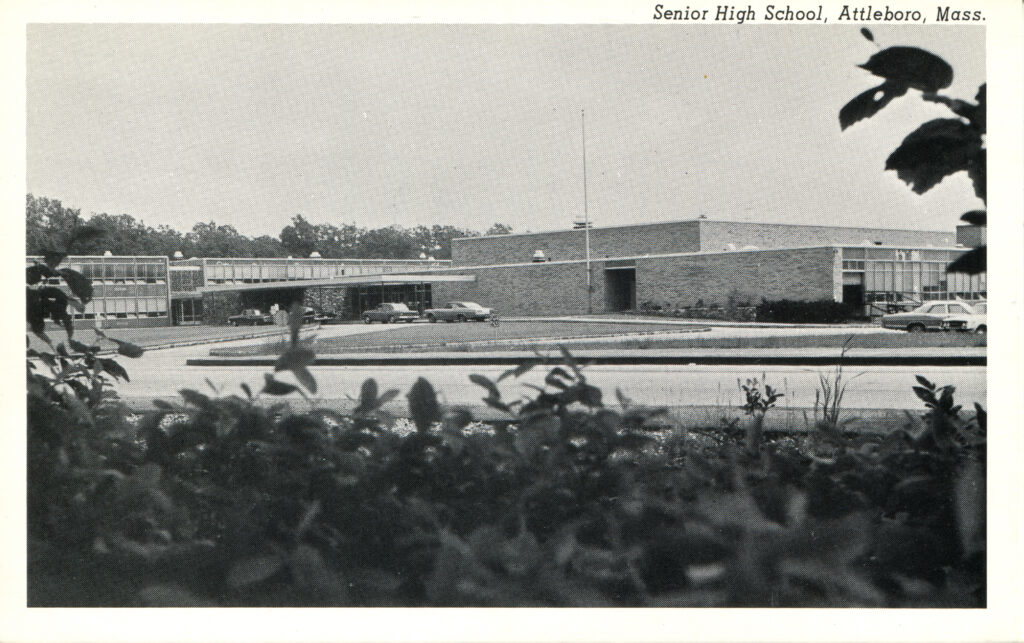
Context:Main Image: The postcard features a black and white photograph of the Senior High School in Attleboro, Massachusetts.
Details:
Architecture:
The building is a modern, mid-20th-century structure characterized by its low profile and horizontal lines.
The school appears to have a flat roof and large, expansive windows typical of the architectural style of the 1950s and 1960s.
The building is divided into multiple sections, likely representing different wings or departments of the school.
The facade is plain with brickwork, emphasizing functionality and simplicity in design.
Setting:
The photograph is taken from a slight distance, with some foliage in the foreground, giving a sense of the school’s setting within a landscaped area.
There are a few cars parked in front of the school, indicative of the era when the postcard was produced.
The surrounding area appears to be well-maintained, with a circular driveway or drop-off area in front of the school.
Text:
At the top right corner of the postcard, the text reads “Senior High School, Attleboro, Mass.” in a clean, serif font.
The text placement and font style are simple, matching the straightforward and functional aesthetic of the photograph.
Interpretation:
Historical Context: This postcard likely dates from the mid-20th century, reflecting the architectural and educational trends of the time. During this period, there was significant growth in public education infrastructure in response to the post-World War II baby boom.
Architectural Significance: The design reflects the mid-century modern architectural movement, which emphasized simplicity, functionality, and the use of new building materials and techniques. The large windows and open layout suggest an emphasis on natural light and a conducive learning environment.
Cultural Importance: High schools played a crucial role in the community, serving as centers of education, socialization, and community events. The modern design of the building reflects the optimism and forward-looking attitude of the era.